Прогноз прохождения радиоволн
 |
Если вы тут впервые, то посетите наш раздел для начинающих - введение к прохождению радиоволн на КВ |
- Прогноз солнечной активности российской лаборатории "ИЗМИРАН"
- Программное обеспечение для расчетов прохождения на своем компьютере
- Ссылки на всемирные источники прохождения радиоволн
Рекомендованные статьи о солнечной активности:
- Ионосфера и ее изучение
- О сверхдальнем распространении на КВ
- Прогноз рабочих частот делаем самостоятельно
- Прогноз тропосферного прохождения
- Сверхдальние QSO: оптимальные направления и периоды
- Прохождение на КВ диапазонах
- Снова сверхдальняя радиосвязь
- Как сделать прогноз прохождения
- Стоит ли повышать мощность?
- СНЭРА: прогнозирование радиоавроры
- О дальнем и сверхдальнем распространении
коротких волн
- Эхо магнитных бурь
- Опасаться или не обращать внимания
- Явления влияющие на прохождение радиоволн
Текущее состояние ионосферы:
|
||||||||||||||||




|
Прогноз авроры в северном полушарии 
|
|
Прогноз УКВ 
|
Прогноз сервера SIDC.BE: (Правила перевода)
Опубликовано: 26 марта 2026 в 1259 UTC

SIDC URSIGRAM 60326

Состояние солнечной активности на 26 марта 2026, 1258UT

Прогноз SIDC

Солнечные вспышки. Ожидаются вспышки класса M (вероятность >=50%)

Геомагнитное поле:  Спокойное состояние (A<20 and K<4)

Солнечные протоны: Спокойное состояние

Прогноз на 26 марта 2026: Солнечный поток в диапазоне 10см: 142 / AP-индекс: 010

Прогноз на 27 марта 2026: Солнечный поток в диапазоне 10см: 145 / AP-индекс: 005

Прогноз на 28 марта 2026: Солнечный поток в диапазоне 10см: 150 / AP-индекс: 010

Комментарий (на английском языке): Solar Active Regions and flaring: Solar flaring activity was moderate over
the past 24 hours, as an M3.9 (SIDC flare 7259) was detected on 26 Mar at
06:23 UTC. It was produced by SIDC Sunspot Group (SG) 832 (NOAA Active
Region [AR] 4403) despite having a Alpha magnetic configuration. The same
SG also produced three C-class flares at the second half of 25 Mar. SIDC SG
834 is another region of interest as it also produced three C-class flares,
although most of it is behind the East limb. Its brightest flare was SIDC
flare 7267, a C5 emitted on 26 Mar at 08:47 UTC. It is most likely a much
brighter flare, but obscured by the solar limb.
Further isolated M-class flares are likely in the next 24 hours, either
from SIDC SG 832 or 834.

Coronal mass ejections: No Earth-directed Coronal Mass Ejections (CME) were
observed in the last 24 hours.

Solar wind: The Solar Wind (SW) conditions returned to a slow SW regime, as
the effects of the High Speed Stream diminished during the last 24 hours.
The SW speed decreased from 600 to 400 km/s, the interplanetary magnetic
field (B) ranged between 3 and 8 nT, and its North-South component (Bz)
varied from -5 nT to 7 nT. A glancing blow from SIDC CME 642 (launched on
22 Mar 23:54 UTC) has a chance of arrival in the next 24 hours, but is
expected to have a minor effect.

Geomagnetism: The geomagnetic conditions were globally (NOAA Kp) and
locally (K BEL) quiet to unsettled during the past 24 hours. They are
expected to remain at quiet to unsettled level during the next 24 hours.

Proton flux levels: The greater than 10 MeV proton flux, as measured by the
GOES-19 satellite, was at background levels over the past 24 hours and is
likely to remain so in the next 24 hours.

Electron fluxes at GEO: During the past 24 hours, the greater than 2 MeV
electron flux as measured by GOES 19 was above the 1000 pfu alert threshold
and ranged between 1000 and 10000 pfu. A small drop is expected in the next
24 hours, however it is likely that the electron flux will remain above the
alert threshold level.
The electron fluence decreased fro high to moderate levels on 25 Mar at
19:35 UTC. It is likely to remain at moderate levels in the next 24 hours.Сегодняшнее значение числа солнечных пятен (International Sunspot Number): 113,

получено на основе анализа результатов 16 станций наблюдения.

Солнечные индексы за 25 Mar 2026

Число Вольфа по данным обсерватории Катания (IT9):    123

Солнечный поток в диапазоне 10см:  140

A-индекс по данным обсерватории Chambon-la-Foret (F): 020

A-индекс по данным обсерватории Wingst (DL):          013

Планетарный А-индекс Ap:                              015

Вчерашнее значение числа солнечных пятен (International Sunspot Number): 113,

получено на основе анализа результатов 22 станций наблюдения.

Прошедшие события на Солнце:

DAY BEGIN MAX  END  LOC    XRAY OP  10CM Catania/NOAA RADIO_BURST_TYPES

26  0611  0623 0631 ////// M3.9          64/4403
(Прогноз бельгийского сервера SIDC - Правила перевода)
|
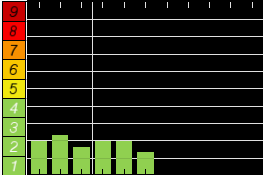
SAF = Прогноз солнечной активности. Показания индекса К снимаются с интервалом
в три часа. Они показывают текущий уровень активности магнитного
поля Земли (в данном случае записаны в городе Boulder, штат Colorado).
Обратите внимание, что это данные могут не соответствовать той географической
зоне, в которой вы находитесь, однако являются в определенной степени
усредненными. |
Состояние магнитного поля:
(Прогноз российской лаборатории "ИЗМИРАН")
(Прогноз российской лаборатории "ИЗМИРАН")
